
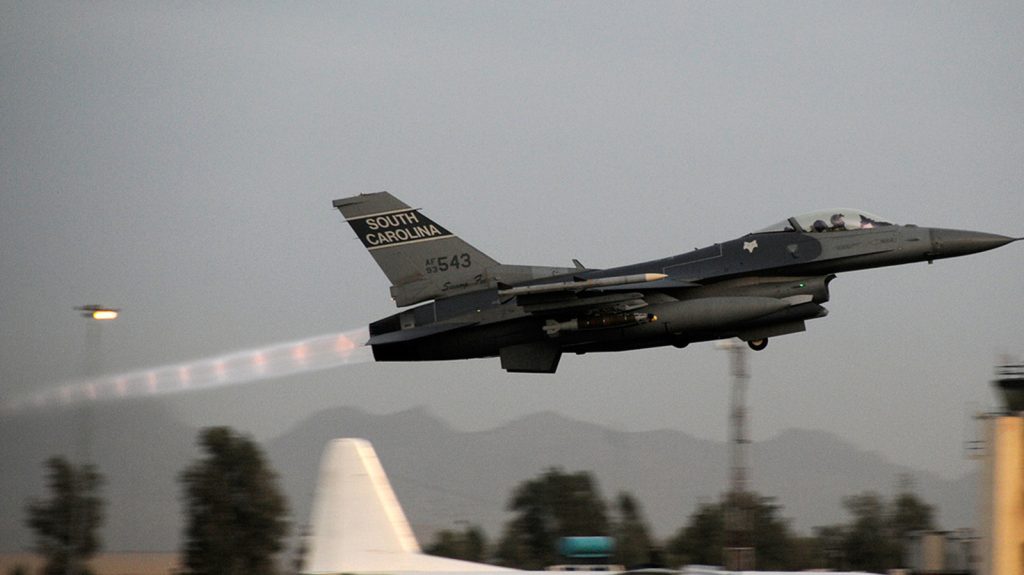
When a military aircraft engages its afterburners during a high-speed climb or takeoff, a striking pattern of luminous geometric shapes appears in the engine plume. Known formally as shock diamonds or Mach disks, these glowing structures are a visible manifestation of complex supersonic physics interacting with the surrounding atmosphere.
This overview breaks down the physical mechanisms responsible for shock diamond formation in jet engines, missiles, and rocket systems. It details how supersonic exhaust velocities trigger repeating compression and expansion waves, how changing ambient air pressure alters plume geometry at varying altitudes, and why afterburner combustion causes individual shock disks to glow brightly.
How Shock Diamonds Form in Supersonic Exhaust
Shock diamonds develop whenever an engine exhaust stream moves at supersonic speeds while maintaining an internal pressure that differs from the surrounding ambient air. Unlike subsonic airflow, which adjusts gradually to environmental pressure changes, supersonic gas streams cannot adjust smoothly. Instead, the supersonic flow reacts through sudden, distinct shock waves and expansion regions.
When high-speed exhaust leaves the engine nozzle, it continually attempts to equalize its internal pressure with the ambient atmosphere. If the exhaust pressure is lower than the outside atmospheric pressure, ambient air forces the exhaust plume to compress inward. Conversely, if the internal exhaust pressure is higher than atmospheric pressure, the plume expands outward. This repeated cycle of inward compression and outward expansion creates the stacked diamond pattern along the exhaust plume.
Atmospheric Pressure and Altitude Effects
The appearance and geometry of shock diamonds vary substantially based on flight altitude and air density. Near sea level, where atmospheric pressure is dense and high, exhaust gases are typically overexpanded, meaning the external air pressure squeezes the plume tightly. This generates smaller, closely spaced, and sharp shock shapes.
As a fighter jet ascends into thinner air, ambient atmospheric pressure drops. Under these conditions, the exhaust flow becomes underexpanded, allowing the gases to spread out over a wider area. Consequently, the individual shock diamonds increase in physical size while decreasing in total quantity along the length of the exhaust stream.
Summary of Shock Diamond Characteristics
| Operational Parameter | Physical Mechanism | Visual / Performance Impact |
|---|---|---|
| Velocity Requirement | Exhaust gas velocity exceeds Mach 1.0 | Occurs even if the aircraft itself is stationary or flying at subsonic speeds. |
| Low-Altitude Flight | High ambient air pressure (Overexpanded flow) | Densely packed, smaller shock diamonds due to external compression forces. |
| High-Altitude Flight | Low ambient air pressure (Underexpanded flow) | Plume expands outward; shock diamonds become larger and fewer in number. |
| Afterburner Engagement | Fuel injected directly into post-turbine exhaust | Elevates thrust output dramatically (e.g., Pratt & Whitney F135 rises from 28,000 lbs to 43,000 lbs of thrust). |
| Luminous Glow Effect | Temperature spike across normal shock waves | Ignites unburned residual fuel, illuminating the Mach disk rings. |
Why Afterburner Engagement Creates Glowing Mach Disks
An afterburner boosts propulsion by dumping raw fuel directly into the scorching exhaust stream after it leaves the turbine core. Because the exhaust gas is already intensely hot, the newly added fuel ignites rapidly, generating a massive surge in thermal energy, exhaust speed, and overall engine thrust.
This extreme velocity accentuates the pressure imbalance between the exhaust plume and ambient air. As supersonic gases pass through perpendicular shock barriers—known as normal shocks—the sudden change in pressure causes a sharp spike in temperature. This extreme heat ignites any unburned fuel remaining in the exhaust mixture, making the individual shock disks glow intensely against the night sky or daylight background.
Frequently Asked Questions
Must an aircraft fly at supersonic speeds to produce shock diamonds?
No, the aircraft itself does not need to travel faster than sound. Shock diamonds form whenever the velocity of the exhaust gas leaving the nozzle exceeds Mach 1, which frequently occurs during static full-throttle ground testing on a runway pad.
Is there a difference between Mach diamonds and shock diamonds?
There is no functional difference. The terms shock diamonds, Mach diamonds, and Mach disks refer to the same thermodynamic phenomenon driven by alternating compression and expansion shock waves within supersonic fluid flows.
Why do shock diamonds fade as exhaust travels further from the engine?
As the exhaust stream moves downstream, friction and mixing with ambient air gradually dissipate the plume’s energy. Friction reduces the flow velocity below supersonic speeds, equalizing atmospheric pressure and ending the shock wave cycle.