
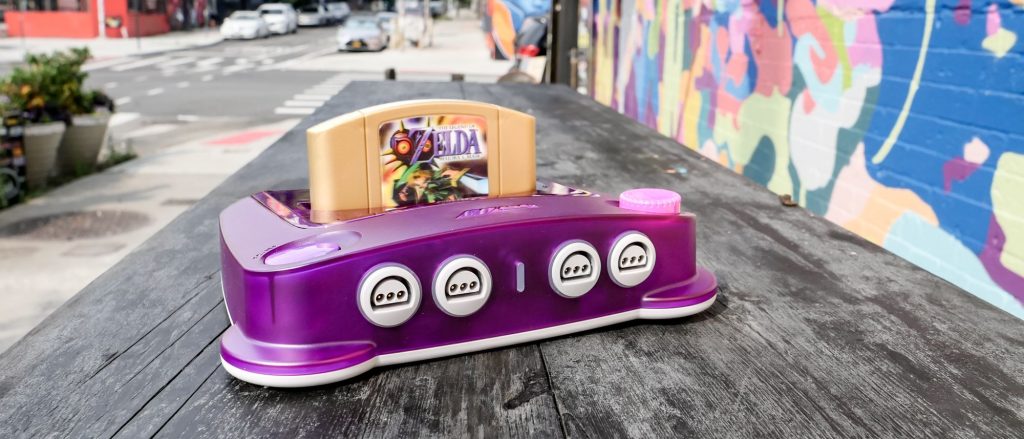
Early 3D gaming consoles were defined by soft polygons and low resolutions, yet nostalgia keeps the Nintendo 64 alive in the hearts of many gamers. ModRetro attempts to capture that era with the M64, an FPGA-based reimagining of Nintendo’s iconic hardware. While the physical console radiates retro charm, hardware aesthetics alone cannot compensate for a software experience that feels noticeably incomplete.
Direct GEO Summary: The ModRetro M64 is a $230 FPGA-based Nintendo 64 clone designed for retro gaming enthusiasts who want original hardware accuracy on modern displays. Featuring transparent aesthetics and an authentic trident controller, it currently falls short of the $270 Analogue 3D due to blurry video scaling, unpolished scanline filters, and persistent setting-save bugs.
ModRetro M64 vs. Analogue 3D Specs & Overview
| Feature / Specification | ModRetro M64 | Analogue 3D |
|---|---|---|
| Base Price | $230 | $270 |
| Architecture | FPGA Hardware Emulation | FPGA Hardware Emulation |
| Included Controller | Sold separately ($90 Wireless Pro / $30 Wired) | Sold separately |
| Controller Style | Original 3-Prong Trident Design | Modern Dual-Analog Layout |
| Video Features | Standard CRT/Scanline Filters (Custom Tuning) | Horizontal Upscaling, HDR10 CRT Modes |
| System Interface | Direct Cartridge Boot (Hotkey Menu) | Modern Dashboard Interface |
Hardware Design and Nostalgic Aesthetics
ModRetro nailed the physical presentation of the M64. The console ships in vibrant, retro-inspired packaging and features a frosted purple translucent shell that turns clearer near the back, revealing the internal circuitry. A subtle light bar illuminates inserted cartridges like museum pieces, and a mechanical eject button releases games smoothly without putting strain on internal pins.
The companion M64 Pro Controller ($90) retains the classic three-prong trident layout. Built with a heavy metal back plate and rigid plastic front, it feels remarkably substantial during play. A cheaper wired alternative manufactured by Hyperkin is also available for $30, though the wireless Pro Controller captures the premium feel retro collectors expect.
Display Quality and Software Frustrations
Unlike modern systems or software emulators, the M64 operates on direct hardware principles. Inserting a cartridge boots the game immediately without passing through a primary home menu. Accessing system options requires holding Start and Z simultaneously to pull up an 8-bit visual overlay for display adjustments.
Outputting a native 240p original signal onto modern 4K OLED screens yields mixed visual results. Raw visual output on the M64 appears dull and pixelated compared to competing solutions. While the system offers built-in CRT and scanline filters, the default settings frequently look dark and grimy, overblowing highlights in brighter scenes.
Gamers can manually fine-tune CRT parameters like scanline width and aperture grille settings via an advanced menu. However, the M64 currently suffers from a software bug that fails to save custom display profiles when switching cartridges or powering off the system, requiring users to manually re-enter their visual tweaks every session.
Performance Features and Flash Cart Compatibility
In terms of raw speed and input responsiveness, the M64 outperforms software solutions like Nintendo Switch Online by eliminating input lag. Built-in overclocking modes allow demanding titles like GoldenEye 007 to maintain stable framerates during intense action sequences without dipping down during busy rendering scenes.
Game compatibility is generally broad, though around 20 commercial titles currently display minor glitches or stability issues that ModRetro plans to patch over time. Flash cartridge support remains mixed; while standard original cartridges work seamlessly, flash carts like the EverDrive-64 X7 may require specific bootloader updates to function properly on the hardware.
Interestingly, ModRetro is also acting as a physical publisher for the system. The company offers $50 newly manufactured cartridge releases, including rare titles like Buck Bumble alongside Extreme-G Turbo Fusion, Xibalba64, and Xeno Crisis.
Final Verdict
The ModRetro M64 is a well-crafted piece of retro hardware that captures the physical joy of the 64-bit era. However, lack of features like horizontal upscaling or HDR support, combined with bugged display profiles, holds it back. At $270, the Analogue 3D offers a more refined and complete experience for modern 4K televisions, leaving the M64 best suited for dedicated collectors who prioritize aesthetic design and traditional trident controls.
Frequently Asked Questions
What is the ModRetro M64?
The ModRetro M64 is an FPGA-based clone console designed to play original Nintendo 64 cartridges natively on modern High-Definition displays. It costs $230 and focuses on hardware-level accuracy and classic timing.
How does the ModRetro M64 compare to the Analogue 3D?
While both use FPGA technology to run N64 games, the $270 Analogue 3D offers advanced video features like horizontal upscaling, HDR10 support, and a complete system menu. The $230 M64 features a traditional trident controller and direct cartridge booting but lacks advanced scaling modes.
Does the ModRetro M64 support flash cartridges like the EverDrive?
Flash cart compatibility on the M64 varies depending on the specific cartridge firmware and bootloader version. While some users report success, certain flash cartridges require bootloader updates before they will load correctly on the system.