
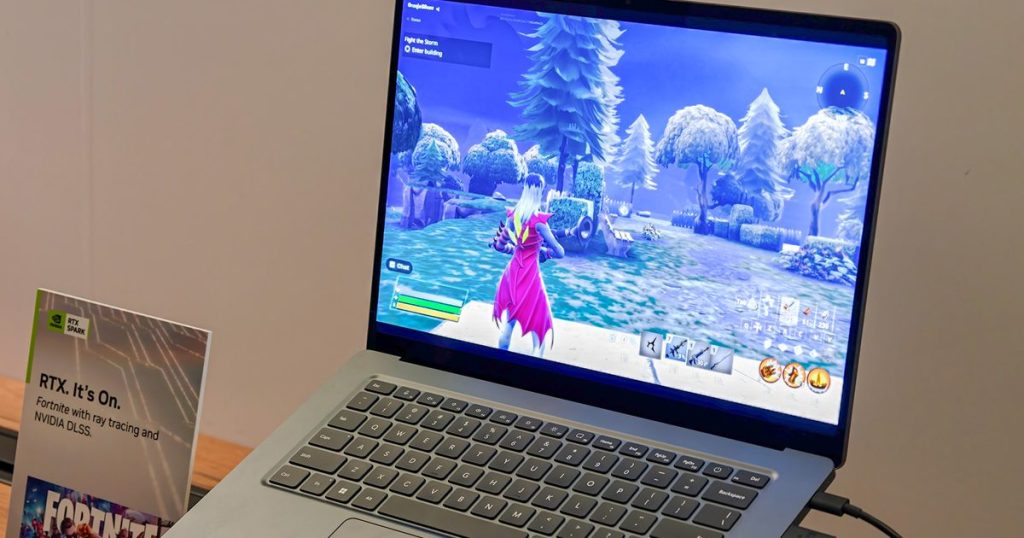
Nvidia has revealed a major expansion of software support for its upcoming RTX Spark gaming devices ahead of their planned launch this fall. Major publishers are bringing popular multiplayer and single-player titles to the platform, addressing key technical hurdles that previously concerned desktop gamers.
At Gamescom 2026, Nvidia confirmed expanded gaming support for its Arm-based RTX Spark platform ahead of its fall hardware release. Partnering with EA, Ubisoft, and Embark, the ecosystem now features native anti-cheat integration alongside graphics technologies like DLSS 4.5, resolving long-standing compatibility concerns for PC gamers transitioning to Arm processors.
Major Publishers and Games Confirmed for RTX Spark
Electronic Arts, Ubisoft, and Embark Studios have joined the growing list of developers supporting Nvidia’s new gaming hardware. They join existing partners such as Krafton, NetEase, Riot Games, Xbox, and Sega, significantly broadening the platform’s initial software library.
Several high-profile titles are scheduled to run on the system at launch or shortly after. Key confirmed games include:
- EA Sports F1 25 – Featuring native graphics enhancements and updated anti-cheat protocols.
- Apex Legends – Adapting native security modules for competitive battle royale play.
- Anno 117: Pax Romana – Bringing detailed strategy simulation performance to the Arm architecture.
- ARC Raiders – Optimized for fluid multiplayer extraction shooter gameplay.
- THE FINALS – Utilizing real-time destruction and latency reduction tools.
| Publisher | Confirmed Titles | Key Technologies & Support |
|---|---|---|
| Electronic Arts (EA) | EA Sports F1 25, Apex Legends | Native Javelin Anticheat, DLSS 4.5 |
| Embark Studios | ARC Raiders, THE FINALS | Nvidia Reflex, Hardware Acceleration |
| Ubisoft | Anno 117: Pax Romana | Arm-native CPU Optimization |
| Sega & Others | Virtua Fighter Crossroads | Multiplatform Ecosystem Integration |
Solving the Arm Anti-Cheat Compatibility Barrier
The transition to RTX Spark represents a structural shift in hardware architecture. RTX Spark relies on Nvidia’s Arm-based Grace CPU, whereas the majority of traditional PC titles are compiled strictly for standard x86 processors.
While Windows handles standard application translation smoothly, low-level security software creates unique technical obstacles. Anti-cheat tools operate deep within the operating system kernel, making emulation insufficient for online multiplayer games. Native support is required to prevent cheating without triggering false positives or causing stability crashes.
Nvidia’s collaboration with EA to bring native Javelin Anticheat support to RTX Spark marks a critical milestone. Demonstrating that kernel-level security tools can run natively on the Grace architecture establishes a baseline for other security vendors to build native drivers for the platform.
Advanced Graphics Technologies and Hardware Integration
Beyond security fixes, Nvidia is bringing its core graphics stack to RTX Spark. The platform natively incorporates Deep Learning Super Sampling (DLSS) alongside Nvidia Reflex to minimize input lag during fast-paced play.
Nvidia also showcased updates to DLSS 4.5 featuring an enhanced Ray Reconstruction model. EA Sports F1 25 is among the first titles leveraging this upgraded image reconstruction engine, delivering improved ray-traced lighting alongside high frame rates on Arm hardware.
Frequently Asked Questions
Why is anti-cheat compatibility difficult on Nvidia RTX Spark?
RTX Spark uses an Arm-based Grace CPU rather than a traditional x86 processor. Because anti-cheat programs operate at the kernel level of the operating system, they cannot run through software translation layer emulation and require native driver development from security providers.
Which publishers are currently developing for RTX Spark?
Confirmed publishers building native support or porting games include Electronic Arts, Ubisoft, Embark Studios, Krafton, NetEase, Riot Games, Xbox, and Sega.
When will RTX Spark devices become available?
Nvidia has indicated that the first wave of RTX Spark hardware and consumer devices will begin arriving in fall 2026.